
This week, we begin a new cycle of Torah readings, starting from those very first words, “In the beginning, God created the heavens and the earth.”
Every year at this time, we read those words against the backdrop of a world that is already turning and moving at thousands of miles an hour. Starting from scratch, as this first verse seems to suggest, is difficult to imagine. However, the second verse creates a different image, which I find easier to contemplate. The earth was tohu va-vohu—unformed, unordered, chaotic. For me, this raises the possibility that the creative work God does in this story is not completely starting from scratch. Rather, it is the work of bringing order to chaos, one day at a time, until the seventh day, when God rests—and the work of sustaining creation passes into the world we inhabit.
There are many ways we, as individuals, families and communities, work to bring order to our world every day, from the practical task of mastering our chaotic lives and schedules, to the moral work of bringing our ethics and values to our actions.
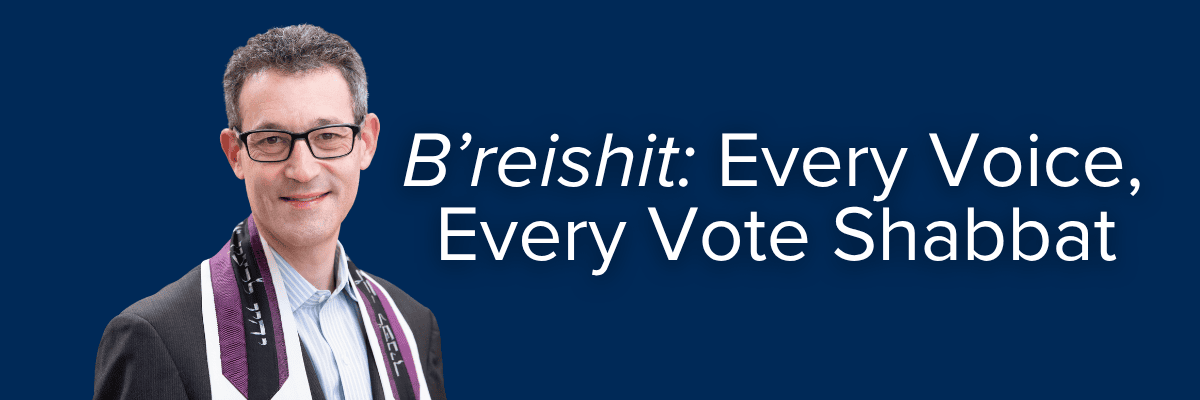
Next Shabbat, the Religious Action Center of Reform Judaism is marking “Every Voice, Every Vote Shabbat,” calling on congregations to reflect on how we engage in the democratic process unfolding this fall. Beginning that conversation a week early, I want to turn our attention to three state constitutional amendments that will be on the Virginia ballot next month, all of which are supported by the Reform Movement. Each of them promises to bring a measure of certainty to a matter that should not be left to chance.
At a time when many states across the South have sharply restricted abortion, Virginia remains a critical point of access to abortion care in the Southeast, including for thousands of people who travel here from other states. The first proposed constitutional amendment would place reproductive freedom in the Virginia Constitution, rather than leaving those protections subject to ordinary legislation. The Reform Movement supports abortion rights because Jewish tradition prioritizes the life and well-being of the pregnant person, affirms individual moral agency, and rejects imposing one religious understanding of when life begins on everyone through law.
Although marriages between same-sex couples are now fully recognized throughout the United States, Virginia still has a same-sex-marriage ban written into its constitution. It cannot currently be enforced because of the Supreme Court’s decision in Obergefell v. Hodges, but it could become enforceable again if that decision were overturned. The second proposed constitutional amendment would remove that ban and replace it with an affirmative protection for marriage equality. The Reform Movement has long supported marriage equality, as Judaism teaches that all people are created b’tzelem Elohim (in the image of God) and deserve dignity and respect.
Currently, under Virginia’s constitution, many people convicted of felonies lose their voting rights and can regain them only through action by the governor. Among other changes, the third amendment would establish a clear rule: people convicted of felonies could not vote while incarcerated, but their voting rights would be restored automatically upon release.
Virginia’s system of felony disenfranchisement has deep roots in the Jim Crow era, when restrictions on voting were deliberately used to diminish Black political power. Its effects remain racially disproportionate today. In addition, Jewish tradition teaches that through teshuvah—repentance—those who have done wrong can earn the chance to rejoin their community, and the purpose of the justice system should be to rehabilitate and reintegrate people rather than continue to stigmatize them after they have reentered society. Most of all, once people return to their communities after incarceration, they should have a voice in determining how those communities are governed.
In each of these cases, rights that matter deeply to people’s lives can still depend on changing laws, court decisions, or the discretion of an individual officeholder. These amendments ask whether some of that uncertainty should be replaced by clearer protections in our state constitution. In that sense, each of them asks us to do something that echoes the opening chapter of Torah: to bring order where uncertainty remains. This November, we have the opportunity to make our voices heard on these important questions.
Wishing you a Shabbat Shalom,
Rabbi Jeff Saxe