

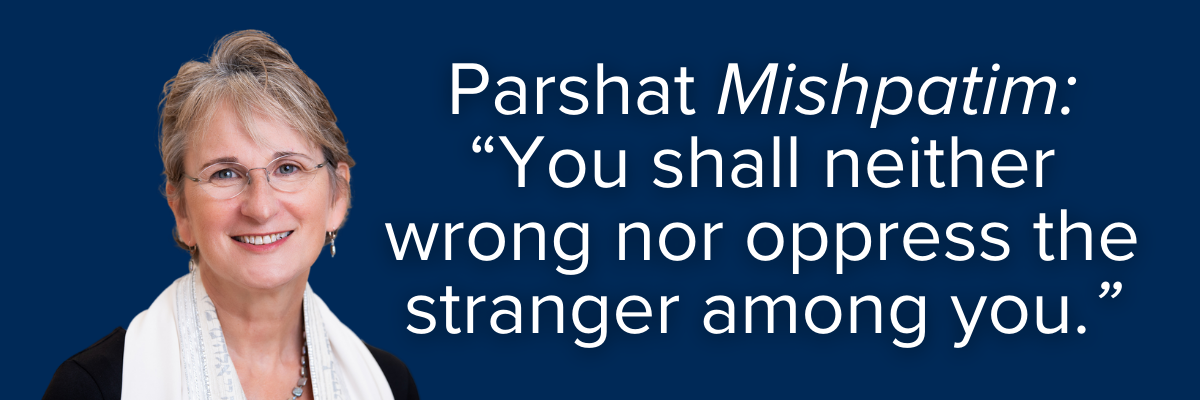
Last week we read the dramatic story of the giving of the Ten Commandments. There were thunder and fire and God’s voice booming from the mountain top. Good movies come from Parshiot like that one! This week we find ourselves in a completely different setting. Parashat Mishpatim lacks the excitement of its predecessor. It contains a long list of rules or laws that govern the Jewish community not only in ancient times but in our day as well. These laws deal with treatment of slaves, crimes of murder, personal injuries, unfair business practices as well as more challenging matters such as lying, witchcraft and idolatry. As in many places in the Torah, the Israelites are reminded to demonstrate sensitivity to the stranger because they were strangers in the land of Egypt. Finally, the portion presents rules for Shabbat, the sabbatical year, Pesach, Shavuot and Sukkot. Upon hearing all these laws, Moses gathers the people to offer sacrifices and declares, “All the things that God has commanded we will do.”
Among the 53 commandments listed in this one portion, one finds itself in the spotlight of our time. In chapter 22 verse 20 we are commanded: You shall neither wrong nor oppress the stranger (Ger) among you, for you were once strangers in the land of Egypt. Surely, we all know this verse well. Not only does it appear 36 times in the Torah, but each year also we read this line at our Passover Seder tables. Now, today, as our country is embroiled in issues of immigration and the truly disturbing actions of ICE, we are hearing preachers of every denomination in America invoke this commandment. No matter your political affiliation, no matter what your views are on the numbers of immigrants we should allow in our country, and even if we all agree that those who are violent criminals should be sent away, all of us are witness to the transgression of this biblical commandment – take care of the stranger, the wanderer, the refugee – they are not an ‘other’, they are as you are and were, a human being in need of safety, security and the basic human rights to which both Judaism and our America are committed.
Let us not forget that it was not only after Egypt that we found ourselves as refugees. Abraham and Sarah left their birthplace so they could have the freedom to worship the One God. Jacob and his sons left their home in search of food. Maimonides escaped persecution at the hands of the Almohads. The first Jewish immigrants to America, who came from Brazil, were looking for a place where they could escape persecution and find economic security. All four of my grandparents’ families fled Lithuania during the pogroms of the 1880’s seeking safety. Abraham Joshua Heschel, Albert Einstein, Mark Chagall, Henry Kissinger, all came to this land to escape the death machine of the Nazis. Are we not the world’s first immigrants, the original stranger and alien?
As we watch the battle over immigration unfold before us, let us not forget our own story. I believe that the Torah demands we remember our years as immigrants, not only because it is part of our story, but because the goal of the Torah is to create a better story for others.
In the coming weeks I fear we will see immigrants under attack in our nearby neighborhoods. I pray we will be spared the violence and upheaval we witnessed in Minneapolis. This Torah portion calls out to us this week; will we be ready to fulfill this commandment next week? Let us not forget: You shall neither wrong nor oppress the stranger (Ger) among you, for you were once strangers in the land of Egypt.
Shabbat Shalom,
Rabbi Amy Schwartzman