
June at TRS is chock-full of joyful Shabbat experiences. We started the month, as we do every year, with Hot Shabbat, and a fabulous (if sticky!) night under the tall trees of Bunny’s Place. This Friday night will be Pride Shabbat, and the Friday night after that, Shabbat coincides with Juneteenth. As we reach the end of the month, we’ll formally launch our summer sermon theme. Meanwhile, every Saturday morning in June (and a few Saturday afternoons), we get to celebrate with wonderful b’nai mitzvah students. Twelve TRS teens become b’nai mitzvah this month.
The world as a whole, unfortunately, has not quite caught on to this spirit of celebration. We are celebrating Pride as rights are being stripped away from Trans and Queer people all around the country. We are approaching Juneteenth on the heels of the gutting of the Voting Rights Act. And, it goes without saying, we are leaning hard into experiences of communal Jewish joy as Jewish communities around the world continue to navigate increasing antisemitism, including antisemitic attacks.
In the face of hatred, violence, and discrimination, against ourselves or against people we love (or people we just know, or know of!), it can be easy to feel small. Violence is, amongst other things, a form of objectification: you temporarily stop being the author of your own experiences while a sentence or a paragraph or a chapter of your story is written by your attacker. You become a person, or a People, who something happened to.
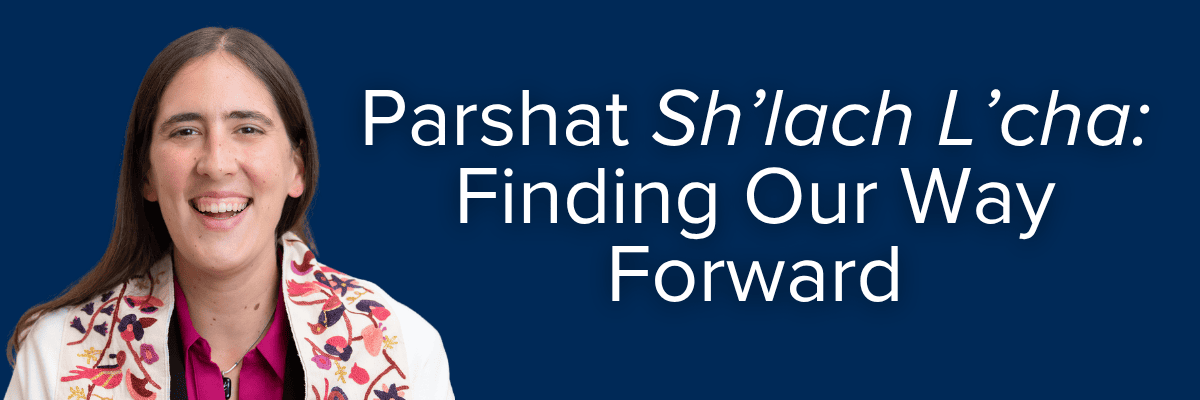
In our Torah portion this week, Sh’lach L’cha, the Ancient Israelites are very much grappling with being a People who something terrible happened to, not too long ago – even as they stand on the shores of the Promised Land, they are still wrestling deeply with the question of what they are capable of, particularly following hundreds of years of enslavement. In Sh’lach L’cha, twelve scouts are sent into the Promised Land to see what’s there, and report back. Famously, two (Joshua and Caleb, the future leaders of the community) return optimistic, and ten return pessimistic. None of the scouts disagree with each other about what they saw: instead, they disagree with each other about what’s possible in the future.
All of the scouts see both challenges and opportunities in the Land, but only Joshua and Caleb believe that the People are equal to the challenges. The other ten say, instead, that the people in the Land seemed like giants to them, and “we were, in our own eyes, like grasshoppers – and so too we [must have been] in their eyes” (Numbers 13:33). Through the influence of the ten scouts, the community as whole becomes convinced that there’s no way forward, and that they’re going to die.
Caught between an uncertain future and a terrible recent past, they feel small. And they have trouble imagining a future for themselves outside of what other people (the “giants”) might do to them.
What protects Caleb and Joshua? What helps them imagine a future full of possibility, a future that they can help create? And what helps them try to bring that more fruitful future into being?
This is a question that has interested Jewish thinkers for many generations. The answers aren’t explicitly in the Torah, and so many of the commentaries that explore this question draw on the insights and lived experiences of the commentators.
One of my favorite, slightly more whimsical approaches to this question, is embedded in a midrash about Joshua’s name.
At the start of this week’s Torah portion, Joshua is named Hosea. And then it is said, as an aside, just before the scouts entered the land: “And Moses called Hosea son of Nun, ‘Joshua.’” (Numbers 13:16).
In Hebrew, the difference between Hosea (Hoshea) and Joshua (Y’hoshua) is just one letter: the tiny letter “yud.” This is also the letter that was dropped from Sarai’s name when she entered the covenant and became “Sarah.” In the midrashic compilation Bereshit Rabba (which we believe dates to the Talmudic period – so it’s about 1500 years old), Rabbi Shimon ben Yohai imagines the letter “yud” flying off of Sarah’s name, and waiting patiently in the heavens for many generations to join Joshua’s (Bereshit Rabba 47:1).
In other words: Moses’ gift to Joshua was not just a new name, but also something important from one of his ancestors, an ancestor who had the courage (along with her spouse) to start a new life, travel to a new place, and begin again. Moses’ gift to Joshua was to remind him that he came from a people who had not only had things happen to them, but who had also made powerful choices – and who had changed their own lives and the lives of others for the better, just as Joshua himself had the power to do.
We have this power, too. As we join in international celebrations of Pride, national celebrations of Juneteenth, and here at TRS, as we lean into myriad opportunities to deepen Jewish community and cultivate Jewish joy, we have the power to write the next chapters of our stories … and work for a world where all of our neighbors can do the same. Across all of the different identities we hold, we come from many people, across many generations, who were brave and resilient and worked for a better future, for themselves and for others. This month, we honor their stories, and remember that we can do the same.
Shabbat Shalom,
Rabbi Alexandra Stein